
The Art of Changing the Brain: Interview with Dr. James Zull
 Learning through a virtuous Learning Cycle. That’s the message from Dr. James Zull, Professor of Biology and Biochemistry at Case Western University, Director of UCITE (The University Center for Innovation in Teaching and Education), and Professor of a Human Learning and The Brain class.
Dr. Zull loves to learn. And to teach. And to build connections. He has spent years building bridges between neurobiology and pedagogy, as a result of which he wrote The Art of Changing the Brain: Enriching the Practice of Teaching by Exploring the Biology of Learning, which shows how neurobiological research can inform and refine some of the best ideas in educational theory.
 In that book, Prof. Zull added biological substrate to David Kolb’s Learning Cycle framework. David Kolb’s Experiential Learning: Experience as the Source of Learning and Development book refers to human learning, but Professor Zull tells that today, in his desk, he has cognitive neuroscience papers and research that show that apes go through the same 4 stages when they are learning a new activity, activating exactly the same brain areas than we do.
AF: What is Learning? Can apes really learn in the same way we do?
JZ: Learning is physical. Learning means the modification, growth, and pruning of our neurons, connections–called synapses– and neuronal networks, through experience. And, yes, we have seen that apes go through the same Learning Cycle as we do, activating the same brain areas.
AF: How does Learning happen?
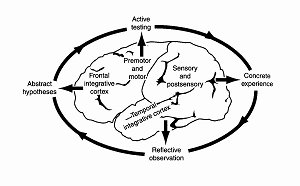
These are the 4 stages of the Learning Cycle.
1) We have a Concrete experience,
2) We develop Reflective Observation and Connections,
3) We generate Abstract hypothesis,
4) We then do Active testing of those hypotheses, and therefore have a new Concrete experience, and a new Learning Cycle ensues.
In other words, we 1) get information (sensory cortex), 2) make meaning of that information (back integrative cortex), 3) create new ideas from these meanings (front integrative cortex) and 4) act on those ideas (motor cortex). From this I propose that there are four pillars of learning: gathering, analyzing, creating, and acting.
This is how we learn. Now, learning this way requires effort and getting out of our comfort zones. A key condition for learning is self-driven motivation, a sense of ownership. To feel in control, to feel that one is making progress, is necessary for this Learning Cycle to self-perpetuate. Antonio Damasio made a strong point on the role of emotions in his great Descartes’ Error book.
AF: can we, as learners, motivate ourselves? How can we become better learners?
JZ: Great question, because in fact that is a uniquely human ability, at least to the degree we can do so. We know that the Frontal Lobes, which are proportionally much larger in humans than in any other mammal, are key for emotional self-regulation. We can be proactive and identify the areas that motivate us, and build on those. In other words, the Art of the Learner may be the Art of Finding Connections between the new information and challenges and what we already know and care about.
If I had to select one Mental Muscle that students should really exercise, and grow, during the schooling years, I’d say they need to build this Learning Muscle. Learning how to Learn. That might be even more valuable than learning what we stress in the curriculum, i.e., the subjects we teach.
AF: Do you think this is happening today in our schools?
JZ: I don’t think so. First, of all, too many people still believe that Education means the process by which students passively absorb information. Even if many educators would like to ensure a more participatory and active approach, we still use the structures and priorities of another era. For example, we still pay too much attention to categorizing some kids as intelligent, some as not so, instead of focusing on how they could all learn more.
Second, learning and changing are not that easy. They require effort, and also, by definition, getting out of our comfort zones. We need to try new things, and to fail. The Active Testing phase is a critical one, and sometimes our hypothesis will be right, and sometimes wrong. The fear of failing, the fear of looking un-smart, is a key obstacle to learning that I see too often, especially for people who want to protect perceived reputations to such an extent that they can’t try new genuine Learning Cycles.
AF: Fascinating. Given what you just said, how do you help your students become better learners?
JZ: Despite the fact that every brain is different, let me simplify and say that I usually observe 2 types of students, with different obstacles to learning and therefore benefiting from different strategies.
A) Students who have an introversion tendency can be very good at the Reflection and Abstract hypothesis phases, but not so at the Active Testing one. In order to change that, I help create small groups where they feel safer and can take risks such as sharing their thoughts aloud and asking more questions.
B) More extroverted students can be very good at having constant Concrete experiences and Active Testing, but may benefit from increased Reflection and Abstract hypothesis. Having them write papers, maybe predicting the outcome of certain experiments or even current political affairs, helps.
AF: Very useful. What other tips would you offer to teachers and parents?
JZ: Always provoke an active reaction, ensuring the student is engaged and sees the connection between the new information and what he or she already knows. You can do so by asking questions such as “What does this make you think of? Is there some part of this new material that rings a wild bell for you?” To ensure a safe learning environment, you have to make sure to accept their answers, and build on them. We should view students as plants and flowers that need careful cultivation: growing some areas, helping reduce others.
AF: Please give us an example.
JZ: Well, an example I use in my books is that middle school students often have a hard time learning about Martin Luther and the Reformation because they confuse him with Martin Luther King Jr. We can choose to become frustrated about that. Or we can exploit this saying something like, “Yes! Martin Luther King was a lot like Martin Luther. In fact, why do you think Martin Luther King’s parents named him that? Why didn’t they name him Sam King?”
AF: Thanks. And what would you suggest for us who want to become better learners?
JZ: Learning is critical at all ages, not only in the school environment. We have brains precisely in order to be able to learn, to adapt to new environments. This is essential throughout life, not just in school. We now know that every brain can change, at any age. There is really no upper limit on learning since the brain neurons seem to be capable of growing new connections whenever they are used repeatedly. I think all of us need to develop the capacity to self-motivate ourselves. One way to do that is to search for those meaningful contact points and bridges, between what we want to learn and what we already know. When we do so, we are cultivating our own neuronal networks. We become our own gardeners.
AF: Prof. Zull, many thanks for sharing your thoughts through your book, and for your time today. You have changed my brain-and probably will change the brains of a number of readers.
JZ: My pleasure!
Share this:

1 Comments
About SharpBrains
Top Articles on Brain Health and Neuroplasticity
Top 10 Brain Teasers and Illusions
Got the book?
interesting