Protect Your Asset by Being Your Own Brain Fitness Coach
 Last week I had the good fortune of spending four days in Nuevo Vallarta, Mexico, with over 300 amazing individuals from 40+ countries who had been named Young Global Leaders by the World Economic Forum. The summit agenda was insightful and inspiring, conversations with other participants always proved to be eye-opening and stimulating, and the overall atmosphere was constructive. You can read more about some of those conversations here.
What I’d like to highlight in this article is the remarkable (and optional) activity that started off every day at 7 in the morning. Called “Protect Your Asset”, it consisted of three scheduled activities: running, yoga, swimming, and other self-driven ones.
Have you ever attended a conference where ‘Protecting Your Asset’ is placed in such a prominent role? I believe it is a sign of hopeful times to come, where we realize that “our Asset” is not our so-called “net worth”, but our brain and mind – the center of our capacity to learn, to understand the environment around us, to envision the role we can play to improve it, and to then make good decisions, regulating behaviors, thoughts and emotions, to become positive changemakers.
If we truly believe our brains are a key asset each of us has to protect, grow, invest in over time, and that “capital is being superseded by creativity and the ability to innovate — and therefore by human talents”, the natural question arises, “How can all of us make informed decisions while navigating the maze of fragmented brain/ mind research, often superficial media coverage and biased marketing claims”?
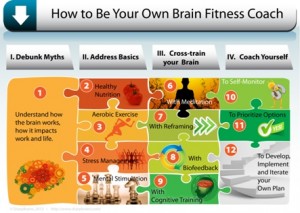
In a class I have taught for several years via UC-Berkeley Osher Lifelong Learning Institute and now online through SharpBrains.com, we approach this as solving a jigsaw puzzle. (Registration to Spring Class is closed, but you can subscribe to our eNewsletter to stay informed about future courses and resources .)
.)
A crucial insight that is often overlooked is that there is no general solution or magic pill that may by itself be enough to “Protect Our Asset.” Instead, there is a growing understanding that a number of lifestyle options and tools, when properly integrated and targeted, can make a clear and sustainable difference on brain health and performance. The four lifestyle factors (or “basics to address”) we highlight above are synergistic- meaning, it makes little sense to focus on just one and ignore the others. A sensible approach would in fact be the opposite: to identify and try to address weak spots which may be acting as bottlenecks. And the same principle applies to the “Cross-train your brain” theme. The benefits from each of those four research-based brain training methodologies are highly complementary, so one would do well to identify and address weak spots through those targeted methodologies. And, to do all this, one needs to learn to self-monitor, to prioritize, to plan.
Let’s then explore the jigsaw puzzle, piece by piece, on How to Protect our Assets by Being Our Own Brain Fitness Coaches:
- Debunk brain myths: we need to first understand “the Asset.” How could we keep our cars running if we didn’t know how and when to add gas and oil?
- Nutrition: Did you know that the brain only weighs 2% of body mass but consumes over 20% of the oxygen and nutrients we intake? As a general rule, we don’t need expensive nutritional supplements to improve brain functioning, but to avoid stuffing ourselves with the “bad stuff”.
- Physical exercise: Aerobic exercise (in any form, including playing sports) brings multiple brain-based benefits; the bare minimum would be 3 times a week, 30 minutes each time.
- Stress management: Stress and anxiety, whether induced by external events or by your own internal processes, contributes to the death of neurons, and lowers the creation of new ones.
- Mental stimulation: The point of having a brain is precisely to learn and to adapt to challenging new environments. Once new neurons appear in our brains, where they migrate and how long they survive depends on how we use them. “Use It or Lose It” does not mean “do crossword puzzle number 1,234,567?. It means “challenge your brain often with new and meaningful activities”.
- Meditation: A great practice to build attention and monitor and regulate mental processes.
- Reframing: We can practice positive, action-oriented, thoughts until they become our default mindset, enabling us to look forward to challenges in a constructive way.
- Biofeedback: Great tool to self-monitor heart rate variability (objective measure of physiological stress) and to build emotional resilience.
- Cognitive training: New computerized brain training tools can help enhance targeted functions that tend to decline with age, such as attention, working memory, and information processing speed.
- Self-monitor: As mentioned above, there are no “magic pills or solutions”. We need to learn how to identify areas that need improvement via introspection and external sources such as (with caution) biofeedback readings and online cognitive assessments and games.
- Prioritize: Often, what we need is to not better answers, but better questions, such as the ones outlined in this 10-question evaluation checklist.
- Coach yourself: At the end of the day, no matter how much I can delegate (or “outsource”) a number of decisions to professionals and to tools, I need to make my own decisions, and mistakes, and learn from them. That way, I am training my own brain, not my neighbor’s.
Protecting Your Asset starts, then, by being your own and well-informed brain fitness coach. For inspiration, one can count on the wisdom of many sharp brains:
“Be the change you want to see in the world.” (Mahatma Gandhi)
“Each man can be, if he so determines, the sculptor of his own brain.” (Santiago Ramon y Cajal)
“Everything should be kept as simple as possible, but no simpler.” (Albert Einstein)
To Learn More:
- The Forum of Young Global Leaders
- Online Course: How to Be Your Own Brain Fitness Coach in 2012
- Book: The SharpBrains Guide to Brain Fitness
- 2012 Virtual Summit: Optimizing Health through Neuroplasticity, Innovation and Data (June 7–14th, 2012)
- SharpBrains monthly eNewsletter
Share this:

About SharpBrains
Top Articles on Brain Health and Neuroplasticity
Top 10 Brain Teasers and Illusions
Got the book?