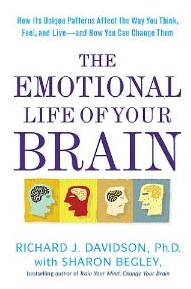
The Emotional Life of Your Brain: One Brain Does Not Fit All
 If you believe most self-help books, pop-psychology articles, and television therapists, then you probably assume that how people respond to significant life events is pretty predictable. Most of us, according to the “experts,” are affected in just about the same way by a given experience—there is a grieving process that everyone goes through, there is a sequence of events that happens when we fall in love, there is a standard response to being jilted, and there are fairly standard ways almost every normal person reacts to the birth of a child, to being unappreciated at one’s job, to having an unbearable workload, to the challenges of raising teenagers, and to the inevitable changes that occur with aging.
These same experts confidently recommend steps we can all take to regain our emotional footing, weather a setback in life or in love, become more (or less) sensitive, handle anxiety with aplomb … and otherwise become the kind of people we would like to be.
But my thirty-plus years of research have shown that these one-size-fits-all assumptions are even less valid in the realm of emotion than they are in medicine. There, scientists are discovering that people’s DNA shapes how they will respond to prescription drugs (among other things), ushering in an age of personalized medicine in which the treatments one patient receives for a certain illness will be different from what another patient receives for that same illness—for the fundamental reason that no two patients’ genes are identical.
The Emotional Life of Your Brain
(One important example of this: The amount of the blood thinner warfarin a patient can safely take to prevent blood clots depends on how quickly the patient’s genes metabolize the drug.) When it comes to how people respond to what life throws at them, and how they can develop and nurture their capacity to feel joy, to form loving relationships, to withstand setbacks, and in general to lead a meaningful life, the prescription must be just as personalized. In this case, the reason is not just that our DNA differs—though of course it does, and DNA definitely influences our emotional traits—but that our patterns of brain activity do. Just as the medicine of tomorrow will be shaped by deciphering patients’ DNA, so the psychology of today can be shaped by understanding the characteristic patterns of brain activity underlying the emotional traits and states that define each of us.
Over the course of my career as a neuroscientist, I’ve seen thousands of people who share similar backgrounds respond in dramatically different ways to the same life event. Some are resilient in the face of stress, for instance, while others fall apart. The latter become anxious, depressed, or unable to function when they encounter adversity. Resilient people are somehow able not only to withstand but to benefit from certain kinds of stressful events and to turn adversity into advantage. This, in a nutshell, is the puzzle that has driven my research. I’ve wanted to know what determines how someone reacts to a divorce, to the death of a loved one, to the loss of a job, or to any other setback—and, equally, what determines how people react to a career triumph, to winning the heart of their true love, to realizing that a friend will walk over hot coals for them, or to other sources of happiness. Why and how do people differ so widely in their emotional responses to the ups and the downs of life?
The answer that has emerged from my own work is that different people have different Emotional Styles. These are constellations of emotional reactions and coping responses that differ in kind, intensity, and duration. Just as each person has a unique fingerprint and a unique face, each of us has a unique emotional profile, one that is so much a part of who we are that those who know us well can often predict how we will respond to an emotional challenge. My own Emotional Style, for instance, is fairly optimistic and upbeat, eager to take on challenges, quick to recover from adversity, but sometimes prone to worry about things that are beyond my control. (My mother, struck by my sunny disposition, used to call me her “joy boy.”) Emotional Style is why one person recovers fairly quickly from a painful divorce while another remains mired in self-recrimination and despair. It is why one sibling bounces back from a job loss while another feels worthless for years afterward. It is why one father shrugs off the botched call of a Little League umpire who called out his (clearly safe!) daughter at second base while another leaps out of his seat and screams at the ump until his face turns purple. Emotional Style is why one friend serves as a wellspring of solace to everyone in her circle while another makes herself scarce—emotionally and literally—whenever her friends or family need sympathy and support. It is why some people can read body language and tone of voice as clearly as a billboard while to others these nonverbal cues are a foreign language. And it is why some people have insight into their own states of mind, heart, and body that others do not even realize is possible.
Every day presents countless opportunities to observe Emotional Styles in action. I spend a lot of time at airports, and it is a rare trip that doesn’t offer the chance for a little field research. As we all know, there seem to be more ways for a flight schedule to go awry than there are flights departing O’Hare on a Friday evening: bad weather, waiting for a flight crew whose connection is late, mechanical problems, cockpit warning lights that no one can decipher … the list goes on. So I’ve had countless chances to watch the reaction of passengers (as well as myself!) who, waiting to take off, hear the dreaded announcement that the flight has been delayed for one hour, or for two hours, or indefinitely, or canceled. The collective groan is audible. But if you look carefully at individual passengers, you’ll see a wide range of emotional reactions. There’s the college student in his hoodie, bobbing his head to the music coming in through his earbuds, who barely glances up before getting lost again in his iPad. There’s the young mother traveling alone with a squirmy toddler who mutters, “Oh great,” before grabbing her child and stalking off toward the food court. There’s the corporate-looking woman in the tailored suit who briskly walks up to the gate agent and calmly but firmly demands to be rerouted immediately through anywhere this side of Kathmandu—just get her to her meeting! There’s the silver-haired, bespoke-suited man who storms up to the agent and, loud enough for everyone to hear, demands to know if she realizes how important it is for him to get to his destination, insists on seeing her superior, and—red-faced by now—screams that the situation is completely intolerable.
Okay, I’m prepared to believe that delays are worse for some people than for others. Failing to make it to the bedside of your dying mother is definitely up there, and missing a business meeting that means life or death to the company your grandfather founded is a lot worse than a student arriving home for winter break half a day later than planned. But I strongly suspect that the differences in how people react to an exasperating flight delay have less to do with the external circumstances and more to do with their Emotional Style.
The existence of Emotional Style raises a number of related questions. The most obvious is, when does Emotional Style first appear—in early adulthood, when we settle into the patterns that describe the people we will be, or, as genetic determinists would have it, before birth? Do these patterns of emotional response remain constant and stable throughout our lives? A less obvious question, but one that arose in the course of my research, is whether Emotional Style influences physical health. (One reason to suspect it does is that people who suffer from clinical depression are much more prone to certain physical disorders such as heart attack and asthma than are people with no history of depression.) Perhaps most fundamentally, how does the brain produce the different Emotional Styles—and are they hardwired into our neural circuitry, or is there anything we can do to change them and thus alter how we deal with and respond to the pleasures and vicissitudes of life? And if we are able to somehow change our Emotional Style (in chapter 11 I will suggest some methods for doing so), does it also produce measurable changes in the brain?
– This article has been adapted by arrangement with Hudson Street Press, a member of Penguin Group (USA) Inc., from The Emotional Life of Your Brain by Richard J. Davidson, Ph.D., and Sharon Begley. Copyright 2012 by Richard J. Davidson, Ph.D., and Sharon Begley.
Share this:

About SharpBrains
Top Articles on Brain Health and Neuroplasticity
Top 10 Brain Teasers and Illusions
Got the book?