By: Greater Good Magazine
Playing the Blame Game
– Video games stand accused of causing obesity, violence, and lousy grades. But new research paints a surprisingly complicated and positive picture, reports Greater Good Magazine’s Jeremy Adam Smith.
Cheryl Olson had seen her teenage son play video games. But like many parents, she didn’t know much about them.
Then in 2004 the U.S. Department of Justice asked Olson and her husband, Lawrence Kutner, to run a federally funded study of how video games affect adolescents.
Olson and Kutner are the co-founders and directors of the Harvard Medical School’s Center for Mental Health and Media. Olson, a public health researcher, had studied the effects of media on behavior but had never examined video games, either in her research or in her personal life.
And so the first thing she did was watch over the shoulder of her son, Michael, as he played his video games. Then, two years into her research—which combined surveys and focus groups of junior high school students—Michael urged her to pick up a joystick. “I definitely felt they should be familiar with the games if they were doing the research,” says Michael, who was 16 at the time and is now 18.
Olson started with the PC game Read the rest of this entry »
By: Dr. Pascale Michelon

Today we have the pleasure to have Dr. Pascale Michelon, one of our new Expert Contributors, write her first article here. Enjoy, and please comment so we hear your thoughts and engage in a nice conversation.
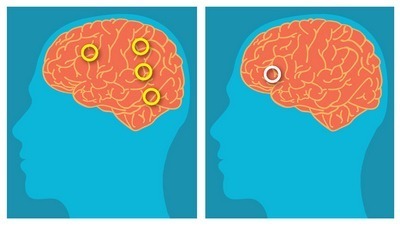
(Btw, if you notice some similarity between the colors in the fMRI scan below and the look & feel of this site…well, the reason is that those orange-grey fMRI colors were our inspiration! the orange color denotes the most brain activation).
- Alvaro
————————————–
You have probably heard about CAT and MRI scans (produced thanks to machines like the one to the top right). So you know that these are techniques that doctors and scientists use to look inside the brain.
You have probably also heard about brain fitness and how important it is to keep a healthy brain to be protected against age-related and disease-related brain damages.
The question we ask here is the following: Can we use brain scans to evaluate how fit the brain is? Before we try to answer this question let’s start with the basics and try to understand how brain scans work.
Brain imaging, also called neuroimaging, allows one to Read the rest of this entry »
By: Alvaro Fernandez
You have survived the 2007 shopping and eating season. Congratulations! Now it’s time to shift gears and focus on 2008…whether you write down some New Year resolutions or contemplate some things that you want to let go of from last year and set intentions and goals for this year — as is a friend’s tradition on the winter solstice.
To summarize the key findings of the last 20 years of neuroscience research on how to “exercise our brains”, there are three things that we can strive for: novelty, variety and challenge. If we do these three things, we will build new connections in our brains, be mindful and pay attention to our environment, improve cognitive abilities such as pattern-recognition, and in general contribute to our lifelong brain health.
With these three principles of brain health in mind — novelty, variety and challenge — let me suggest a few potential New Years resolutions, perhaps some unexpected, that will help you make 2008 a year of Brain Fitness: Read the rest of this entry »
By: Alvaro Fernandez
There has been an interesting discussion about the issues related to the aging of the legal profession. Stephanie introduced us to the article “the Graying Bar: let’s not forget the ethics” by David Giacalone.
In short: statistics about the increasing ratio of lawyers over 70 in active practice, on the one hand, and the general incidence of Alzheimer’s and other dementias, on the other, lead David to point out an increasing likelihood that some lawyers may be practicing in less than ideal conditions for their clients, beyond a reasonable “brain age”. The question then becomes: who and how can solve this problem, which is only going to grow given demographic trends?.
We are not legal experts, but would like to inform the debate by offering 10 considerations on healthy aging and job performance from a neuropsychological point of view, that apply to all occupations:
1– We should talk more about change than about decline, as Sharon Begley wrote recently in her great article on The Upside of Aging — WSJ.com (subscription required).
We discussed some of these effects with Dr. Elkhonon Goldberg, who wrote his great book The Wisdom Paradox precisely on this point, at The Executive Brain and How our Minds Can Grow Stronger.
2– Some skills improve as we age: In our “Exercising Our Brains” Classes, we typically explain how some areas typically improve as we age, such as self-regulation, emotional functioning and Wisdom (which means moving from Problem solving to Pattern recognition). As a lawyer accumulates more cases under his/ her belt, he or she develops an automatic “intuition” for solutions and strategies. As long as the environment doesn’t change too rapidly, this growing wisdom is very valuable.
3– …whereas, yes, others typically decline: Read the rest of this entry »