By: Dr. Dharma Singh Khalsa @ Alzheimer's Research & Prevention Foundation
As the president and medical director of the Alzheimer’s Research and Prevention Foundation (ARPF), it’s my job to stay on top of advances in the field of Alzheimer’s research. Recently, a number of articles in the medical literature have caught my attention. They are focused on a particular question that concerns most Baby Boomers like me: “Is memory loss just a normal part of aging?” Read the rest of this entry »
By: SharpBrains

Sponsored Ad (How to Advertise on SharpBrains.com)
Time for our monthly eNewsletter tracking recent news and developments on how the neuroscience of cognition and emotions can inform education and health across the lifespan. Let us try to be as concise as possible, so you can spend as much time as possible connecting with your Loved Ones instead of with the World Wide Web.
Wishing you a wonderful end of 2011 and a happy and successful 2012!
PS: thirty-nine people have registered since this past Tuesday to participate in the upcoming Online Course: How to Be Your Own Brain Fitness Coach in 2012. Please remember we will only be able to accomodate the first two hundred registrants, so please take a look soon to see if you are interested in joining!
By: SharpBrains
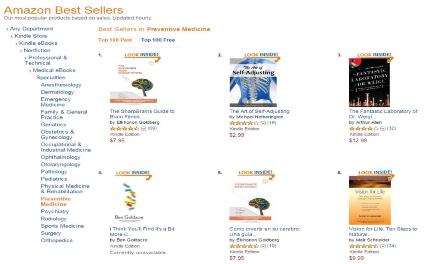
We just noticed that The SharpBrains Guide to Brain Fitness: 18 Interviews with Scientists, Practical Advice, and Product Reviews, to Keep Your Brain Sharp has become #1 book in Amazon Kindle store’s Preventive Medicine section, #1 in Neuropsychology section, and #2 in Cognitive Psychology section.
To learn more and order book in several stores (Amazon, Barnes & Noble, Smashwords) & countries (USA, Canada, UK, Germany, France, Spain, Italy), please click Here.
By: Alvaro Fernandez
You may have noticed that Amazon.com is sharing aggregated data on how ebook readers interact with the books they are reading. For example, the “Popular Highlights” section (towards the bottom of our Kindle book page) ranks the Top 10 sentences that Kindle readers have highlighted and shared while reading The SharpBrains Guide to Brain Fitness: 18 Interviews with Scientists, Practical Advice and Product Reviews, to Keep Your Brain Sharp (April 2009; 182 pages; ranked #1 in Kindle Store’s Preventive Medicine section).
This information is invaluable to authors and publishers - as you can imagine, we’ll make sure to not only maintain but to elaborate on these topics as we prepare future editions of the book.
So, what are so far the Top Ten Quotes on Lifelong Neuroplasticity and Neurogenesis, Read the rest of this entry »
By: Dr. Simon Evans
Given the current political climate, we are pleased to host this thought-provoking article by 2 of our Expert Contributors. Dear Mr or Mrs Next President: how can you help our minds take better care of our brains?
————–
Ask Not What The Health System Can Do For You…
– By Simon J. Evans, PhD and Paul R. Burghardt, PhD.
With the presidential debates gearing up again we are sure to hear more about health care. But we propose a slightly different question. In addition to asking how we can get more people healthcare coverage, we should also ask why so many people are sick in the first place.
The words of John Kennedy might today be, “Ask not what the health care system can do for you. Ask what you can do to reduce the health care burden”. But before delving into what we can do, let’s take a look at some realities that our next president could face in their first ‘State of the Union’ address.
Read the rest of this entry »
By: Caroline Latham
What a busy week, last one. We will be writing during the week about some of the SharpBrains events that occured.ÂÂ
The May/June Issue of Stanford Magazine has a nice section titled Just One Question, where a number of Stanford alumni answer the question “What do people in your profession know that you wish everyone knew?”
Some of our favorite answers:
- Zoe Lofgren, ’70, represents California’s 16th district in Congress. “When all is said and done, the American people decide the kind of American government they get. It’s largely a myth that elected officials disregard the viewpoints of their constituents. That only happens when voters forgo the opportunity to express their point of view or when an elected official (knowingly or not) is preparing to leave his or her elected office. A dozen unscripted, individual letters on a subject are enough to galvanize a member of Congress representing 670,000 people.”
- Doug Osheroff, the J.G. Jackson and C.J. Wood Professor of Physics, won the Nobel Prize in physics in 1996. “I wish that more people had an understanding and appreciation of how science is done. That is, how scientists are able to expand the boundaries of our knowledge and at the same time develop new techniques and technologies that really do benefit mankind.”
- Spencer Sherman, MA ’69, PhD ’71, is a clinical psychologist in Santa Barbara, Calif. “Psychotherapists know that it’s okay to be not okay. That everyone suffers sometimes. That suffering is not unending, unendurable or without value. That confusion and despair have meaning, and that out of them wisdom and compassion emerge. That help exists and that it is sage to ask for it. That strength can be built and happiness learned. That trials and mistakes are necessary parts of that learning. That there is no life free from pain. That it is the pain that drives the growth. That flowers thank the soil from which they rise.”
- (we are biased here) Alvaro Fernandez, MBA ’01, MA ’02, is CEO and co-founder of SharpBrains, Inc. “Many cognitive neuroscientists wish that more people knew how flexible our brains are throughout our whole lives and what a big difference we can make to ensure a healthy, fit, brain and mind. We can exercise our brains—not just our biceps.”
You can check more answers to Just One Question.