By: SharpBrains
Who said, “So for me the most exciting takeaway from this year’s CES (Consumer Electronics Show) isn’t the smart car or the smart home, it’s the smart person…” You can find the answer, and many insights on brain health innovation, by reading SharpBrains’ January 2013 eNewsletter. Enjoy!
- Digital health meets consumer electronics and brain training, by Dr. Evian Gordon and Dr. Gregory Bayer
- Retooling Brain Care With Low-Cost, Data-Driven Technologies, by Alvaro Fernandez
- A conversation on ‘The Optimism Bias’ with neuroscientist Tali Sharot, by David Coleiro
- Why scientific literacy and learning enhance brain function and neural health, by Hemal Pathak, PhD
- Best brain health fitness tip? “Never let status quo be an option”, with Dr. Sandra Chapman
- 10 predictions on how digital platforms will transform brain health in 2013, by Alvaro Fernandez
- Why, to improve memory, we need to think of the brain as a system, with Alvaro Fernandez
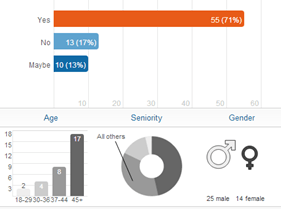
- Quick poll: 71% would take an “annual mental check-up”
Note: We’ll host a 90– minute webinar on Wednesday, February 6th, to discuss the main analysis and forecasts from SharpBrains’ new market report “The Digital Brain Health Market 2012–2020: Web-based, mobile and biometrics-based technology to assess, monitor and enhance cognition and brain functioning,” and to connect them with main take aways from CES 2013 and the just finished World Economic Forum.
–> To learn how to access the webinar and the report, click HERE
By: SharpBrains
Reinforcing the results from the more extensive survey included in our new market report, 71% respondents to a quick LinkedIn poll we just run say they would take a brief assessment every year as an “annual mental check-up.”
A few sample comments: Read the rest of this entry »
By: Alvaro Fernandez
82% of respondents to a 2012 SharpBrains survey (n=3,165) agreed/ strongly agreed with “Adults of all ages should take charge of their own “brain fitness” without waiting for their doctors to tell them to,” and 77% agreed/ strongly agreed with “I would personally take a brief assessment every year as an “annual mental check-up.” This growing awareness demands new ways to harness neuroplasticity across the lifespan to optimize health, productivity and quality of life, and highlights market opportunities. Click Here to see full Summit agenda, including 35+ speakers, 6 product presentation/ demos and 5 educational workshops.
By: Alvaro Fernandez
As mentioned before, the World Economic Forum asked me to write “an 800 words summary of your most compelling actionable idea on the challenges of gerontology”, in preparation for the Inaugural Summit of the Global Agenda that will take place November 7 to 9th in Dubai.A good number of SharpBrains readers and clients offered their insights — and expressed an interest in reading the draft. So below you have — a proposal to create a Global Consortium for Neurocognitive Fitness Innovation, building on our existing market research and advisory services work. Your thoughts?
—–
The Context
Growing Demands on Our Brains: Picture 6.7 billion Primitive Brains inhabiting a Knowledge Society where lifelong learning and mastering constant change in complex environments are critical for productive work, health and personal fulfillment.
Welcome to Planet Earth, 2008.
Further stretched by increased longevity: Now picture close to 1 billion of those brains over the age of 60 – and please remember that, less than 100 years ago, life expectancy was between 30 to 40 years. The rapidly evolving Knowledge Society is placing new and enormous demands on our “primitive” human brains. And the longer our lifespans, the more obvious the “cognitive gap”. Hence, from a health point of view, the growing Read the rest of this entry »
By: Alvaro Fernandez
Just saw a very interesting press release regarding computer-based neurocognitive assessments — a critical part of the brain fitness puzzle. How long will it take before consumers can have access to a reliable and credible annual “mental check-up”/ cognitive baseline?
HeadMinder Cognitive Stability Index: Computerized Neurocognitive … (Press release)
- “The HeadMinder web-based Cognitive Stability Index (CSI) has proven more useful for blast-concussion detection than the ANAM computerized test battery the DoD currently employs. The CSI provides an immediate solution to clear the backlog of 400,000 IED-exposed service members in less than two years.”
- “The CSI is a 30-minute, Internet-based, computerized test that provides automated, objective measures of attention, memory, response speed, and processing speed for initial evaluation of cognitive functioning. The CSI produces standardized reports that enable triage and decision-making appropriate to a user’s qualifications — from medic to neuropsychologist to neurologist and other treatment team members.”
We covered this emerging type of assessments in the article Computerized Cognitive Assessments: opportunities and concerns
- “In fact, one of the Read the rest of this entry »