Sharp Brains: Brain Fitness and Cognitive Health News

Neuroplasticity, Brain Fitness and Cognitive Health News

New market report analyzing the growing Digital Brain Health market 2012–2020
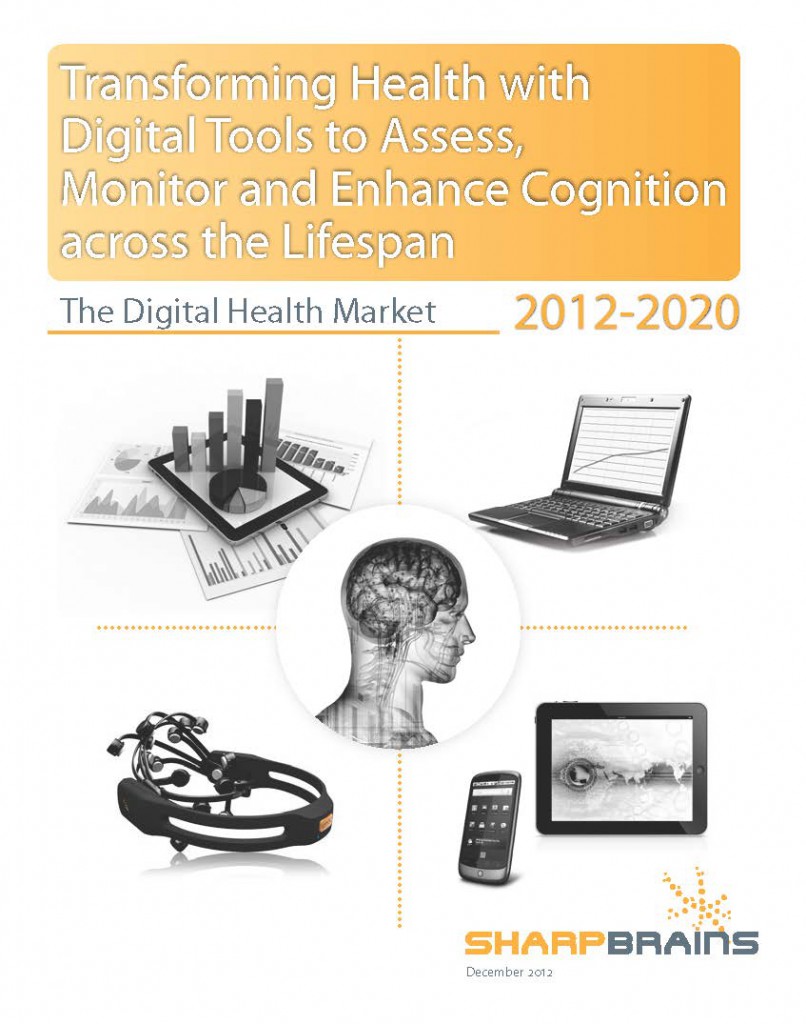
We are proud to release today what we believe is our best mar­ket intel­li­gence report so far, track­ing how fully auto­mated appli­ca­tions designed to assess, mon­i­tor and/ or enhance cog­ni­tion and brain func­tion­ing are trans­form­ing brain health, and health overall.

Here are a few exam­ples of what we mean by Dig­i­tal Brain Health, selected from among the 5 Mar­ket Lead­ers and 10 Com­pa­nies to Watch in 2013/2014 iden­ti­fied through our com­pre­hen­sive analysis.

  • A 30-minute online brain health assess­ment and per­son­al­ized brain fit­ness pro­gram used by large com­pa­nies like Nation­wide Insur­ance and Accen­ture to improve employee’s pro­duc­tiv­ity and men­tal wellness
  • An online cog­ni­tive train­ing pro­gram offered by sev­eral large AAA chap­ters to mem­bers age 50+ to improve dri­ving safety
  • A com­put­er­ized cog­ni­tive behav­ioral ther­apy offered by the NHS in the UK as a first-line inter­ven­tion for anx­i­ety and depression
  • A fully dig­i­tal head­set and plat­form that mea­sures basic brain states (such as level of atten­tion) and is being used to help peo­ple med­i­tate bet­ter and reduce ADHD symptoms
  • An iPad-based assess­ment that tracks cog­ni­tive per­for­mance over time to help detect con­cus­sions among football/ hockey play­ers and mil­i­tary per­son­nel Read the rest of this entry »

Research: Cognitive Behaviour Therapy Helps Adults with ADHD

Many adults with ADHD do not obtain their diag­no­sis until adult­hood and have strug­gled with dif­fi­cul­ties related to undi­ag­nosed ADHD for their entire lives. As doc­u­mented in recent stud­ies, this includes ele­vated rates of depres­sion, anx­i­ety dis­or­ders, sub­stance use, work dif­fi­cul­ties and inter­per­sonal problems.

As with chil­dren and ado­les­cents, med­ica­tion treat­ment for adults with ADHD can be quite help­ful, espe­cially for reduc­ing core ADHD symp­toms of inat­ten­tion and hyperactivity/impulsivity.  How­ever, Read the rest of this entry »

Maker of cognitive training game seeks FDA approval

Good brief arti­cle at New Sci­en­tist, Maker of cog­ni­tive train­ing game seeks FDA approval:

- “Imag­ine walk­ing away from a doctor’s office with a pre­scrip­tion to play a video game. Brain Plas­tic­ity, the devel­oper of a cog­ni­tive train­ing game, has begun talks with the Food and Drug Admin­is­tra­tion (FDA) to mar­ket the game as a ther­a­peu­tic drug.”

- “Brain Plas­tic­ity has been fine-tuning a game to help peo­ple with schiz­o­phre­nia improve the deficits in atten­tion and mem­ory that are often asso­ci­ated with the disorder.”

What kind of attention is involved in ADHD?

An excel­lent arti­cle by the Dana Foun­da­tion clar­i­fies what the “Real Deficit in Atten­tion Deficit/Hyperactivity Dis­or­der” is. Thank you to John from our Sharp­Brains’ group in LinkedIn for point­ing it out.

Among other things, this arti­cle shows you that atten­tion is more com­plex than you prob­a­bly thought: Read the rest of this entry »

Update: Know Thyself, Know How Your Brain Works

What is work­ing mem­ory, and why it mat­ters? Can we multi-task as good as we seem to assume? What should we all know about how our brains work, and why?

We hope you enjoy this August eNewslet­ter, fea­tur­ing six dis­tin­guished con­trib­u­tors who answer those ques­tions, and more. Please remem­ber that you can sub­scribe to receive this free Brain Fit­ness eNewslet­ter by email, using the box in the right column.

Know Thy­self

Why work­ing mem­ory mat­ters in the knowl­edge age: As Dr. Tracy Alloway points out, one way to visu­al­ize work­ing mem­ory is as the brain’s “Post-it Notes” — we make men­tal scrib­bles of bits of infor­ma­tion we need to remem­ber and work with. With­out enough work­ing mem­ory we can­not func­tion as a soci­ety or as indi­vid­u­als. Learn more by par­tic­i­pat­ing in this study launched by Dr. Alloway’s team in con­junc­tion with the British Sci­ence Festival.

What should every­one learn about the brain?: Dr. Jo Ellen Rose­man and Mary Kop­pel from the Amer­i­can Asso­ci­a­tion for the Advance­ment of Sci­ence (AAAS) dis­cuss recent rec­om­men­da­tions on what all stu­dents should know. Not just the basics of brain struc­ture and func­tion, but also a good under­stand­ing of men­tal health—such as the mind/body rela­tion­ship, fac­tors that shape behav­ior, ways of cop­ing with men­tal dis­tress, and the diag­no­sis and treat­ment of men­tal disorders.

News

Pool­ing data to accel­er­ate Alzheimer’s research: A good arti­cle in the New York Times presents the rea­sons behind grow­ing research of how to detect Alzheimer’s Dis­ease. A pilot study shows how com­put­er­ized cog­ni­tive train­ing may help reduce falls among elderly. Amazon.com rec­om­mends The Sharp­Brains Guide to Brain Fit­ness in a thought-provoking mix.

Beyond News

Needed: fund­ing for inno­v­a­tive research on slow­ing cog­ni­tive decline via cog­ni­tive train­ing: Sharp­Brains reader and UK researcher Nick Almond shares a note debunk­ing the so-called BBC brain train­ing exper­i­ment  and out­lin­ing the type of research he and col­leagues at Leeds Uni­ver­sity deem necessary.

Long-term effects of neu­ro­feed­back treat­ment for ADHD: Dr. David Rabiner reviews the 6-month follow-up of a sci­en­tific study on whether neu­ro­feed­back can help kids with atten­tion deficits, find­ing that ben­e­fits indeed remained 6 months after treat­ment had ended. Given, how­ever, that only around 50% of chil­dren showed ben­e­fits, it is impor­tant to regard this tool as part of a mul­ti­modal treat­ment program.

Brain Teaser

Test your atten­tional focus and multi-tasking: How often do you read a doc­u­ment while talk­ing on the phone with a client? Or think about your prob­lems at work while help­ing your child with his home­work? Human atten­tion is lim­ited, and we need to man­age it well, as shown in this teaser pre­pared by Dr. Pas­cale Mich­e­lon.

Have a great Sep­tem­ber. And, should you hap­pen to be in Barcelona, Spain, on Sep­tem­ber 14th, make sure to attend Alvaro Fer­nan­dez talk there titled “How and Why Dig­i­tal Tech­nol­ogy Will Trans­form Edu­ca­tion, Train­ing and Brain Health”.

Long-term effects of neurofeedback treatment for ADHD

Neu­ro­feed­back — also known as EEG Biofeed­back — is an approach for treat­ing ADHD in which indi­vid­u­als are pro­vided real-time feed­back on their brain­wave pat­terns and taught to pro­duce and main­tain pat­terns con­sis­tent with a focused, atten­tive state. This is often done by col­lect­ing brain­wave, i.e., EEG, data from indi­vid­u­als as they focus on stim­uli pre­sented on a com­puter screen. Their abil­ity to con­trol the stim­uli, for exam­ple, keep­ing the ‘smile on a smi­ley face’, is con­tin­gent on main­tain­ing the brain­wave pat­tern being trained.

Neu­ro­feed­back sup­port­ers believe that learn­ing this dur­ing train­ing gen­er­al­izes to real world sit­u­a­tions and results in improved atten­tion and reduced hyperactive/impulsive behav­ior. Although a num­ber of neu­ro­feed­back stud­ies have yielded promis­ing results it remains some­what con­tro­ver­sial with some researchers argu­ing that lim­i­ta­tions of these stud­ies pre­clude firm con­clu­sions about the effec­tive­ness of neu­ro­feed­back from being drawn.

Last year I reviewed a par­tic­u­larly well-conducted study of neu­ro­feed­back treat­ment for ADHD — see my review here. The study was con­ducted in Ger­many and began with 94 chil­dren aged 8 to 12. All had been care­fully diag­nosed with ADHD and over 90% had never received med­ica­tion treat­ment. About 80% were boys.

Chil­dren were ran­domly assigned to receive either 36 ses­sions of neu­ro­feed­back train­ing or 36 ses­sions of com­put­er­ized atten­tion train­ing. The com­put­er­ized atten­tion train­ing task was intended to serve as the con­trol inter­ven­tion and pro­vided equal amounts of time work­ing on a demand­ing cog­ni­tive task under the super­vi­sion of an adult; the inclu­sion of this con­trol con­di­tion is a real strength of the study.

The main find­ings were as fol­lows: Read the rest of this entry »

References on Cognitive Health/ Brain Fitness

This is a par­tial list of the lit­er­a­ture we reviewed dur­ing the research phase of our new book, The Sharp­Brains Guide to Brain Fit­ness.  We know many friends of Sharp­Brains are researchers, health­care pro­fes­sion­als, graduate/ Ph.D. stu­dents, who want have direct access to the ref­er­ences (per­haps PubMed should pro­mote itself as a never end­ing source of men­tal stim­u­la­tion?), so here you have this list, orga­nized by rel­e­vant chap­ter. Please note that the list below appears in the book — whose man­u­script we had to close in Jan­u­ary 2009.

Intro­duc­tion

Basak, C. et al. (2008). Can train­ing in a real-time strat­egy video game atten­u­ate cog­ni­tive decline in older adults? Psy­chol­ogy and Aging.
Beg­ley, S. (2007). Train your mind, change your brain: How a new sci­ence reveals our extra­or­di­nary poten­tial to trans­form our­selves. Bal­lan­tine Books.
DeKosky, S. T., et al. (2008). Ginkgo biloba for pre­ven­tion of demen­tia: a ran­dom­ized con­trolled trial. Jour­nal of the Amer­i­can Med­ical Asso­ci­a­tion, 300, 2253–2262.
Doidge, N. (2007). The Brain that changes itself: Sto­ries of per­sonal tri­umph from the fron­tiers of brain sci­ence. Viking Adult.

Chap­ter 1. The Brain and Brain Fit­ness 101

Bunge, S. A., & Wright, S. B. (2007). Neu­rode­vel­op­men­tal changes in work­ing mem­ory and cog­ni­tive con­trol. Cur­rent Opin­ion In Neu­ro­bi­ol­ogy, 17(2), 243–50.
Dama­sio, A. (1995). Descartes error: Emo­tion, rea­son, and the human brain. Pen­guin Press.
David Kolb, D. (1983). Expe­ri­en­tial learn­ing: Expe­ri­ence as the source of learn­ing and devel­op­ment. FT Press.
Dra­gan­ski, B., Gaser, C., Kem­per­mann, G., Kuhn, H. G., Win­kler, J., Buchel, C., & May A. (2006). Tem­po­ral and spa­tial dynam­ics of brain struc­ture changes dur­ing exten­sive learn­ing. The Jour­nal of Neu­ro­science, 261231, 6314–6317.
Gage, F. H., Kem­per­mann, G., & Song, H. (2007). Adult Neu­ro­ge­n­e­sis. Cold Spring Har­bor Lab­o­ra­tory Press, NY.
Gard­ner, H. (1983). Frames of Mind: The the­ory of mul­ti­ple intel­li­gences. New York: Basic Books.
Gaser, C. & Schlaug, G. (2003). Brain struc­tures dif­fer between musi­cians and non-musicians. The Jour­nal of Neu­ro­science, 23, 9240–9245. Read the rest of this entry »

Top Articles on Brain, Cognition and Neuroplasticity

  1. Do you believe these neu­romyths?, by SharpBrains
  2. Brain Plas­tic­ity: How learn­ing changes your brain, by Pas­cale Michelon
  3. In the Age of Google, Should Schools Teach Mem­o­riza­tion Skills?, by Bill Klemm
  4. Does cog­ni­tive train­ing work? (For Whom? For What?), by Pas­cale Michelon
  5. The Emo­tional Life of Your Brain, by by Richard David­son, Sharon Begley
  6. Cur­rent State of the Sci­ence behind Neu­ro­feed­back Treat­ment for ADHD, by David Rabiner
  7. To Be (Your Con­nec­tome), or Not to Be (Your Genome), by Sebas­t­ian Seung
  8. Top 10 Brain Fit­ness Future Trends, by Alvaro Fernandez
  9. Biofeed­back now a “Level 1 — Best Sup­port” Inter­ven­tion for ADHD, by SharpBrains
  10. When 1 + 1 = 5: Dyscal­cu­lia and Work­ing Mem­ory, by Tracy Alloway
  11. Train­ing Atten­tion and Emo­tional Self-Regulation — Inter­view with Michael Pos­ner, by Alvaro Fernandez
  12. The Ten Habits of Highly Effec­tive Brains, by Alvaro Fernandez
  13. Why do You Turn Down the Radio When You’re Lost?, by Car­o­line Latham
  14. Brain fit­ness Q&A: Mem­ory, stress, emo­tions, by Alvaro Fernandez
  15. Cog­ni­tive ther­apy or med­ica­tion? Brain scans may help per­son­al­ize treat­ments, by SharpBrains
  16. New Study shows Teens with ADHD helped by Cog­ni­tive Behav­ioral Ther­apy, by David Rabiner
  17. How Do Words Change Our Brains and Lives?, by Andrew New­berg, Mark Waldman
  18. BBC “Brain Train­ing” Exper­i­ment: the Good, the Bad, the Ugly, by Alvaro Fernandez
  19. Sci­en­tific cri­tique of BBC/ Nature Brain Train­ing Exper­i­ment, by Liz Zelinski
  20. From Anti-Alzheimer’s “Magic Bul­lets” to True Brain Health, by Alvaro Fer­nan­dez, Peter Whitehouse
  21. Why Agile Minds Deploy Both Ratio­nal and Intu­itive Problem-Solving, by Judith Tingley
  22. Why I Wrote The Woman Who Changed Her Brain, by Bar­bara Arrowsmith-Young
  23. The Busi­ness and Ethics of the Brain Fit­ness Boom, by Alvaro Fernandez
  24. Break­ing Down the Cog­ni­tion & Alzheimer’s Dis­ease Alpha­bet Soup, by Dharma Singh Khalsa
  25. Top 10 Quotes on Life­long Neu­ro­plas­tic­ity, by Alvaro Fernandez
  26. To Har­ness Neu­ro­plas­tic­ity, Start with Enthu­si­asm, by Helena Popovic
  27. Q&A with Yaakov Stern on Brain Reserve, Exer­cise, Cog­ni­tive Train­ing, Angry Birds, by Alvaro Fernandez
  28. It is Not Only Cars That Deserve Good Main­te­nance: Brain Care 101, by Alvaro Fernandez
  29. Eval­u­a­tion Check­list for Brain Fit­ness prod­ucts and games, by Alvaro Fernandez
  30. Mind­ful­ness and Med­i­ta­tion in Schools for Stress Man­age­ment, by Jill Sutie
  31. Stress and Neural Wreck­age: Part of the Brain Plas­tic­ity Puz­zle, by Gre­gory Kellet
  32. Cog­ni­tive and Emo­tional Devel­op­ment Through Play, by David Elkind
  33. AARP’s Brain Fit­ness Best Books List, by SharpBrains
  34. Judith Beck: Train Your Brain to Think Like a Thin Per­son, by Alvaro Fernandez
  35. Improve Mem­ory with Sleep, Prac­tice, and Test­ing, by Bill Klemm
  36. 10 Brain Tips To Teach and Learn, by Lau­rie Bartels
  37. Dr. Elkhonon Gold­berg on Cog­ni­tive Train­ing and Brain Fit­ness, by Alvaro Fernandez
  38. Mind­ful­ness Med­i­ta­tion for Adults & Teens with ADHD, by David Rabiner
  39. Phys­i­cal Exer­cise and Brain Health, by Pas­cale Michelon
  40. Sleep, Tetris, Mem­ory and the Brain, by Shan­non Moffet

Welcome to SharpBrains.com

As seen in The New York Times, The Wall Street Jour­nal, CNN and more, Sharp­Brains is an inde­pen­dent mar­ket research and think tank track­ing health, edu­ca­tion, and pro­duc­tiv­ity appli­ca­tions of neuroscience.

Register Now at Discounted Rates

2013 SharpBrains Summit

Watch 10 Predictions on Digital Brain Health in 2013 (3 minutes)

Cover_video
Enter Your Email and Sub­scribe to our free Monthly eNewslet­ter:
Join more than 40,000 Sub­scribers and stay informed and engaged.

Follow Us Via…

twitter_logo_header