

When 1 + 1 = 5: Dyscalculia and Working Memory
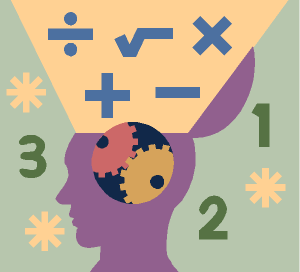 Jacob’s mother writes that ‘Jacob, 10-years-old, still struggles with number bonds to 10. Learning to tell the time is still slow – he has not mastered half-past. Although he managed to learn his 5x tables because we practiced all summer, this has now gone’.
Jacob has dyscalculia, a math disability where students struggle to learn or understand mathematics. Students with dyscalculia find it difficult to decipher math symbols (e.g. +, –), counting principles (‘two’ stands for 2), solving arithmetic problems, and usually transpose numbers (e.g. 75 becomes 57). However, dyscalculia encompasses more than problems with numbers – there is also a struggle with telling the time as in Jacob’s case, identifying left from right, and recognizing patterns.
But why do some students struggle to learn numbers and certain mathematical principles?
Working Memory plays a key role. To solve a mathematical problem like 1 + 1, we need to use our Visuo-Spatial Working Memory. Visuo–spatial working memory functions like a big mental blackboard that gives us a space to write all of the numbers necessary to solve a problem.
It also works together with the brain’s calculator known as the Intraparietal Sulcus (IPS), located in the right hemisphere. Brain imaging studies that looked at brain activity while people were counting and calculating quantities reveal that when we count, regardless of whether it is shapes, numbers, or objects, the IPS is activated. In dyscalculics, this area underperforms and may underpin their maths difficulties.
Like Jacob, the student with dyscalculia has clear working memory deficits. However, the link between working memory and math skills depends on the age of the child as well as the type of math task. Verbal working memory plays a strong role in math skills in seven-year-olds and is a reliable indicator of dyscalculia in the first year of formal schooling. Once children reach adolescence, verbal working memory is no longer significantly linked to mathematical skills. One explanation for this change is that verbal working memory plays a crucial role for basic arithmetic skills like learning arithmetic rules and retaining relevant data such as carried digits when they are young. However, as children get older other factors such as number knowledge and strategies play a greater role.
If you are working with a student with dyscalculia, it is important not only to address their difficulties with numbers, but to also assess their Working Memory. It is possible that they have a small mental blackboard (visuo-spatial Working Memory) that is making it harder for them to apply their number knowledge in a classroom situation.
 – Tracy Packiam Alloway, PhD, is an Assistant Professor at the University of North Florida. She was recently awarded the prestigious Joseph Lister Award by the British Science Association for her contribution to science. Tracy developed a standardized working-memory tests for educators published by Psychological Corporation, which to date has been translated into 15 languages and used to screen for working memory problems in students with dyslexia, motor dyspraxia (Developmental Coordination Disorder), ADHD and Autistic Spectrum Disorder. She provides consultancy to the World Bank and her research has received widespread international coverage in hundreds of media outlets, including Scientific American, the BBC, Reuters, ABC News, and NBC.
Reference
Alloway, T.P. & Passolunghi, MC. (2011). The relations between working memory and arithmetical abilities: A comparison between Italian and British children. Learning and Individual Differences, 21, 133–137.
To learn more:
- 10% Students may have working memory problems: Why does it matter, by Tracy Alloway
- Try Thinking and Learning without working memory, by Bill Klemm
Share this:

4 Comments
About SharpBrains
Top Articles on Brain Health and Neuroplasticity
Top 10 Brain Teasers and Illusions
Got the book?

Are the neurophysical correlates of working memory deficits the result of biologically ordained structural/processing insufficiencies (maladaptive bio-development) (1) or are the neuro-physiological correlates of working memory deficits the result of a lack of neurophysical exercise/activity due to learned maladpative processing schema? For a related example, a recent study of dyslexia moved us closer to understanding the signature of dyslexia prior to beginning reading (http://www.medpagetoday.com/Neurology/GeneralNeurology/30835) but here too the testing is far downstream from the influence of early learning. Isn’t disentangling the genetically-determined from the learning-formed much more subtle than we are acknowledging? Are the brain differences correlated with memory deficits described here exclusively the result of gene-formative processes or could there be a much deeper and richer and more subtle realm of early learning that can also result in the brain differences you are describing?
Hi David, thanks for taking the time to comment. It looks like there are at least 3 questions here, so I will try to address them in turn (and briefly!). The first question seems to me to be why some children have WM deficits, while others don’t. This is a tricky one and the jury is still out. We do know that WM is not greatly affected by environmental factors (eg, financial background, mother’s educational level, etc), unlike other cognitive skills in general ability (IQ scores). So why do some kids struggle: one possibility is they start off with a smaller WM (or ‘post-it-note’ as I have referred to it in the past). Another possibility is that for some reason they are not able to use all of their WM capacity, sometimes b/c of stress or anxiety. So although they have the capacity to do well, they are not maximizing it.
Q2: Genetics. There is some research (and I am in the midst of completing some as well) indicating there is a a strong genetic component to WM capacity. This idea fits well with my previous point about WM being minimally affected by environmental factors.
Q3: Brain differences: The question could be rephrased to look at whether there is less activation when some people use WM to solve a problem, vs brain size (cortical thickness, etc). We do know that lower scores on WM tests are linked to less brain activation in the PFC. However, there is less research on actual brain size and WM scores. Hope this helps.
Thank for this article Doctor. Would the math issue be lessened if the musical part of the brain was used to assist?
My father volunteered using protocols from what was the Philadelphia Brain Injury Clinic. Despite having lost 1/2 his brain in a tragic auto accident (he was a bystander) with a very regimented 14 hour+ day of therapy his recovery from given up for dead to mid level function was amazing.
Thank you for sharing this insight.
I’m a generalist in the field of resiliency.
One of our programs helps foster parents, grand parents, parents of special needs children learn key skills to assist them gain some added self-awareness and self-management skills
https://www.facebook.com/InnerResilience
Michael
Toronto Canada
P.S. I should have said my father was one of the volunteers helping the gentleman that had been seriously injured.