

Lee Woodruff: the Bob Woodruff Foundation, and You, can help Traumatic Brain Injury survivors
You have may have seen a few weeks ago the interview between former US presidential contender John Edwards and reporter Bob Woodruff. All the resulting media coverage centered on Edwards’ declarations. However, there is something much more remarkable that surfaced at that interview: Bob Woodruff’s spectacular recovery.
This is the same reporter who suffered a severe traumatic brain injury when a roadside 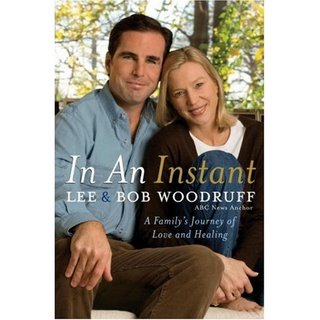 bomb detonated next to his vehicle in January 29th 2006 as he was covering news developments in Iraq.
Today we are fortunate to interview Lee Woodruff, Bob’s wife and pillar throughout his recovery. Lee and Bob co-wrote the fantastic book In an Instant: A Family’s Journey of Love and Healing
Alvaro Fernandez: Lee, many thanks for your time. I was amazed reading your book, where you share your journey, and then watching Bob interview John Edwards, the best display I can imagine of his recovery. Can you please summarize for us what Bob ‑and you- went through since January 2006?
Lee Woodruff: As you know, Bob suffered a life-threatening traumatic brain injury in Iraq. He was promptly taken under military care and underwent a series of surgeries for head injuries, with a joint Army & Air Force neurosurgical team in Iraq, in a US Army Medical Command hospital in Germany, and at Bethesda Naval Hospital, back here in the US.
During this time, spanning around 4 months, he spent 37 days in coma, and his skull had to be surgically rebuilt. The cognitive rehabilitation process started then, at a medical facility closer home.
Can you please explain what kind of cognitive rehab Bob has gone though-both in a formal way, with a therapist, and informally, on his own?
The first thing I’d like to say is that rehab is a long process. Doctors told me that Bob, despite the severity of his injuries, had better chances to recover than other victims, because of the reserve of neurons and connections he had built thanks to an intellectually stimulating and diverse life, including living in China for several years and traveling to dozens of countries, having worked as a lawyer and as a journalist, and his overall curiosity and desire to learn. It seems that more and more research shows how people who are mentally active throughout their lives, either through their jobs, or doing puzzles, sudokus…are, of course up to a point, better prepared to deal with problems such as TBI.
Still, recovery is a long process. Bob had six months of structured cognitive therapy focused on speech and languages areas, because that was the part of his brain that had been most damaged. The therapist identified the main tasks for him to work on in a challenging, yet familiar way, usually asking Bob, for example, to read the New York Times, then try to remember what he had read, and write a short essay on his thoughts and impressions.
Since then he has, in a sense, used his work in the documentary To Iraq and Back and other projects at ABC as his informal, but very effective, way to keep improving. I am amazed to watch in real time how, even today, how he gets better and better. To give you an example of his motivation to recover: he recently took on Chinese lessons to see if working on that also helped him.
In the book, Bob says that, if he had to say in one word what he was experiencing during much of the recovery, he would use the word “slower”. His brain was slower at processing new information, at remembering words. What progress has he experienced?
A lot. He is not exactly at the same level he was before the injury, but he is again an amazing reporter, father, and husband. And I see progress every month, so we have hope that he will continue getting better and better.
Sometimes Bob tells me he is not the person I married. And then, as I mention in the book, I laugh and reply “I am not either. I’m older, wiser and more wrinkled.”
I have learned to trust him. Especially in the beginning, it wasn’t always easy to fully accept and follow his judgment, but I have seen how little by little he grew perfectly able to recreate his role as a husband and as a father, and to recreate our respective roles in the family. It has been wonderful to see that happen. It has been a miracle.
Bob has been a very fortunate survivor of traumatic brain injury. There are over a million cases every year of TBI. Many of them are military-related (a recent RAND study estimates that over 300,000 US service members have sustained TBI during assignments in Iraq or Afghanistan), but also happen in civilian life, mainly due to traffic accidents or sports concussions. What do we know today about how to prevent and treat TBI?
The Iraq War is literally re-writing the book, the way researchers and doctors see and tackle the problem. Most of the progress is happening in the military, but I hope that transfers into benefits for civilians, too. From a preventive point of view, the military has been stepping up to improve the body armor of soldiers, and I can now see why wearing seat belts as we drive and helmets as we bike can make a big difference.
From the recovery point of view, there is much more optimism and hope today than only a few years ago about how many TBI patients can improve, if given the opportunity to, through a supportive environment and physical and cognitive therapy. The military has recognized the problem of the so-called “Walking Wounded’, and is devoting significant resources to analyzing best options and treating them. As we chatted earlier, the Army recently announced that from now on soldiers will get a cognitive screening before they get deployed to the field, so that in case there are problems that screening can serve as a good baseline to compare functions to.
But the improvement in the area is only starting. We need to see much progress.
Can you now tell us more about the Bob Woodruff Foundation for Traumatic Brain Injury? What are your main priorities?
Bob and I are devoting much time to raising awareness of the problem and the need to find and implement good solutions for cognitive care. Our foundation supports community, grass-roots approaches to helping TBI survivors and their families. Given the huge scale of the problem among the military, and the fact that Bob survived thanks to the excellent care he received from the military along the way, we are focusing first on helping military victims.
For example, we recently funded four scholarships for TBI-related research, and also bought 300 mattresses for a small non-profit that helps patients and their spouses rebuild their lives once they have to leave Army bases-many of whom cannot afford to move all their belongings, including beds and mattresses, out of the bases.
And there are many more things to do. For example, while many more soldiers are getting better care, that is not always the case with National Guard reservists who, despite having a dedicated branch of the armed forces oversee their progress, are often at more at risk of living with undetected TBI since they don’t have to report at bases once they are back.
It is also not clear that the military (as well as insurance companies) are always willing to pay for the long-term costs of care.
What are some specific ways people can support the work of your foundation?
They can visit our new website, Bob Woodruff Foundation (http://remind.org/), to learn about the problems and to donate funds, no matter how big or small. We are also holding a fundraising event in NYC in November to raise awareness.
But probably the most important thing every one can do is to recognize the sacrifices the soldiers have made, and find active ways to look for them and help them in their own communities. Soldiers and their families often have grown in a culture of self-reliance, of not asking for help, so here we all need to take the initiative to figure out how we can help. Ask yourself, how can I help the TBI survivors in my neighborhood? Perhaps by giving them a job, or offering them help or training, so they can secure one? How can I help their spouses and families maintain healthy and happy environments? Perhaps by offering them free movie tickets? A massage?
Lee, many thanks for those suggestions. I do have friends at a local Veteran Affairs hospital, and will follow-up on those great ideas. I hope our readers can also think of ways they can help (and exercise their brains along the way). Is there something else you would like to add, that you would know everyone to be aware of?
I’d say never give up. We have seen how Bob has recovered, which I think is a miracle. Let’s simply try our best to help everyone out there.
For further information:
- Book: In an Instant: A Family’s Journey of Love and Healing
— Foundation: Bob Woodruff Foundation.
Related interviews:
- Build Your Cognitive Reserve — Dr. Yaakov Stern
- Dr. Elkhonon Goldberg on Cognitive Training
- Cognitive Simulations: Interview with Prof. Daniel Gopher
Share this:

14 Comments
About SharpBrains
Top Articles on Brain Health and Neuroplasticity
Top 10 Brain Teasers and Illusions
Got the book?

thanks for your book. It was fantastic.I’m a brain injury survivor. I had 2 strokes on the same weekend and ended up with a brain injury from it. I got a chuckle when you were describing the speech problem.same thing happened to me.I do go to a support group in Atlanta.
sincerely,
Leigh Elliott
Leigh, thank you for your comment. We wish you a good and continued improvement!
Please e‑mail address of Foundatio n so that I can mail a contribution. Thankyou
Hello Francine, I haven’t seen their address online, so I guess they prefer you make the donation using their online system. Or you can contact their customer support to ask if they accept alternatives (phone, mail).
Thank you for your interest in supporting their great work!
Our local VFW Post #4760 Men’s Auxiliary group would like to donate to this very worthy cause. We would like to send a check and can’t find a mailing address. Could you please provide? Thank you- Sincerly,
President
Bill Sutherland
My neurologist, Doug Katz at Braintree Rehab Hospital, recently gave me a copy of In An Instant, and I’m enjoying it; I’m finding parallels to my own recovery from a diffuse axonal injury sustained in a car accident in August 2006.
I recently returned from shooting a film in Beijing about the emerging environmental movement in China, but as I’m producing this film, I’m thinking about the next project.
It has been recommended to me that I write a book similar to In An Instant, to benefit others in similar situations. The stigma needs to be taken away from brain injury cases in order to improve recovery rates.
Bill, I have forwarded your note to the Woodruff Foundation. Thank you very much.
Tessa, glad to hear about your recovery and creative rehabilitation process. I couldn’t agree more that stigma itself does not do any good, we need to raise the level of awareness to encourage recovery processes. Thank you for sharing your experience.
Address:
Bob Woodruff Foundation
PO Box 955
Bristow, VA 20136
Hi Alvaro,
Thank you so much for responding. We did eventually find an address and our Men’s Auxiliary from the VFW have already sent a check. We hope it helps.
Merry Christmas!
Bill and Kathy Sutherland
thank you
Do you have an educational program geared to the public in general — children in school in particular that will help in explaining brain injury and the impact on society — how to understand? how to avoid? how to deal with?
I am looking at putting together an education effort for the state of Montana at the public and private school facilities to educate children now so as to ensure when they become adults, not only will they have valuable personal health information for themselves and others, but won’t have to go begging to the legislature every year for a pittance of funding. Education at an early age will help to improve this situation.
Thank you.
Dorothea Sams (mother of a TBI individual)
406/449‑5108
I am a survivor of brain injury.
It’s nice to see someone work as hard as you at your recovery, while helping others.
Carl R.
Alvaro, I’m so happy to have come across this again. I am now considering writing a book about my brain injury recovery. It has been adamantly suggested by many colleagues, I have an editor and a funder who could be interested in involvement in this project. In a very idealistic way, I think this kind of project, like the Woodruff book, can help to improve recovery processes for patients. I have been sitting on the project now for a while, and I could be swayed either way. Alvaro, do you have any thoughts?
Dorothea: the CDC offers many resources, see http://www.cdc.gov/TraumaticInjury/
Tessa: well, Bob’s experience certainly suggests that the process of filming a documentary and writing a book has been an integral component of his ongoing recovery, so I’d encourage you to share your experience aswell!
Many thanks. The ideas you have presented have clarified many aspects of traumatic injury I’ve been musing over for some time as a non medical person with a great interest in memory